
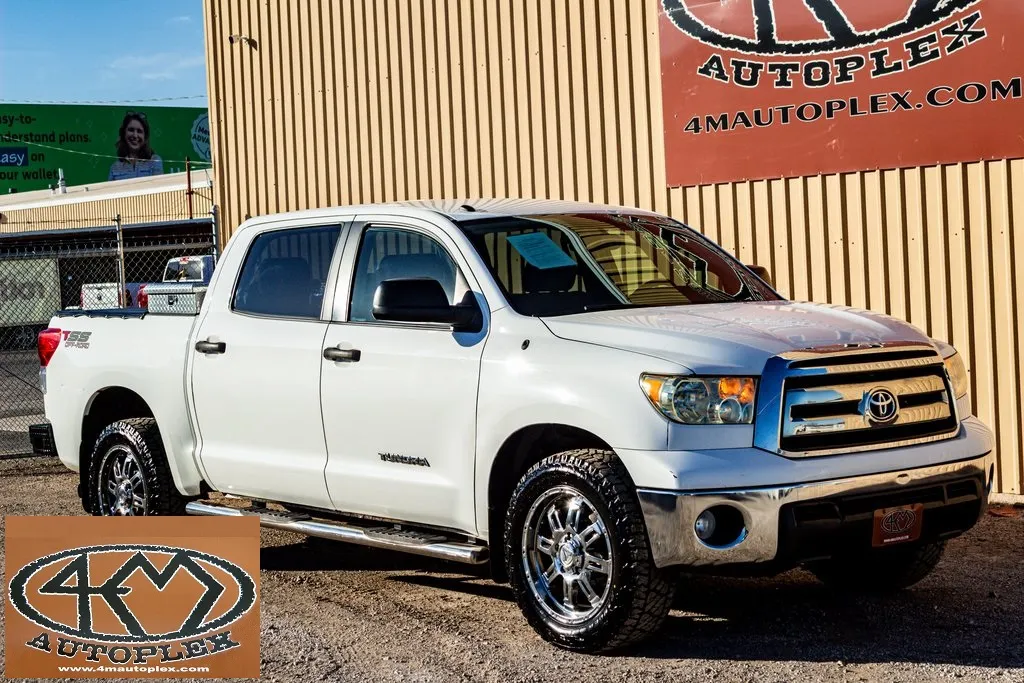
 Satellite radio ready
 Side impact airbags
What type of fuel does a 2013 Toyota Tundra Grade use?
A 2013 Toyota Tundra Grade uses Gasoline with fuel tank capacity up to 26 gallons.
What is the 2013 Toyota Tundra Grade fuel capacity?
A 2013 Toyota Tundra Grade has the fuel capacity of 26 gallons.
How much horsepower does a 2013 Toyota Tundra Grade have?
A 2013 Toyota Tundra Grade has 310 horsepower.
How much torque does a 2013 Toyota Tundra Grade have?
A 2013 Toyota Tundra Grade has 327 lb-ft torque.
What is the 2013 Toyota Tundra Grade load capacity?
A 2013 Toyota Tundra Grade has a load capacity of 1550 lbs.
What is the 2013 Toyota Tundra Grade towing capacity?
A 2013 Toyota Tundra Grade has a towing capacity of 7000 lbs.
What is the 2013 Toyota Tundra Grade city fuel economy / miles per gallon?
A 2013 Toyota Tundra Grade has a city fuel economy of 15 mpg.
What drivetrain does the 2013 Toyota Tundra Grade have?
The 2013 Toyota Tundra Grade has a rear-wheel drive (RWD) drivetrain.
What transmission does the 2013 Toyota Tundra Grade have?
The 2013 Toyota Tundra Grade has a 6-Speed Automatic Electronic with Overdrive transmission.
What engine does the 2013 Toyota Tundra Grade have?
The 2013 Toyota Tundra Grade is equipped with a 4.6L V8 DOHC 32V VVT-i engine.
How many passengers does the 2013 Toyota Tundra Grade seat?
The 2013 Toyota Tundra Grade seats 6 passengers.
What is the gross vehicle weight rating of the 2013 Toyota Tundra Grade?
The 2013 Toyota Tundra Grade has a GVWR of 6800 lbs.
What is the bed length of the 2013 Toyota Tundra Grade?
The 2013 Toyota Tundra Grade has a bed length of 66.7.
What is the wheelbase of the 2013 Toyota Tundra Grade?
The 2013 Toyota Tundra Grade has a wheelbase of 145.7.
What front tires does the 2013 Toyota Tundra Grade have?
The 2013 Toyota Tundra Grade has P255/70R18 front tires.
What rear tires does the 2013 Toyota Tundra Grade have?
The 2013 Toyota Tundra Grade has P255/70R18 rear tires.
What front wheels does the 2013 Toyota Tundra Grade have?
The 2013 Toyota Tundra Grade has 18.0 x 8.0 front wheels.
What rear wheels does the 2013 Toyota Tundra Grade have?
The 2013 Toyota Tundra Grade has 18.0 x 8.0 rear wheels.
Does the 2013 Toyota Tundra Grade have Satellite radio ready?
Yes, the 2013 Toyota Tundra Grade has Satellite radio ready.
Does the 2013 Toyota Tundra Grade have Side impact airbags?
Yes, the 2013 Toyota Tundra Grade has Side impact airbags.
What safety features does the 2013 Toyota Tundra Grade have?
The 2013 Toyota Tundra Grade is equipped with dual front knee airbags, front side airbags, rear side curtain airbags, front side curtain airbags, 4-wheel abs, auto-locking power door locks, trailer stability control, ventilated disc rear brake, braking assist, ventilated disc front brake, dual front airbags, power brakes, latch system child seat anchors, passenger switch airbag deactivation, electronic brakeforce distribution, stability control, traction control, front seatbelt pretensioners, front seatbelt force limiters, driver emergency locking retractors.
SOLD
This one got away, but we have many more to choose from!
Browse All InventoryView Similar Inventory
What's your car worth?
Get your trade-in valueThis one got away, but we have many more to choose from!

Information deemed reliable, but not guaranteed. Interested parties should confirm all data before relying on it to make a purchase decision. All prices and specifications are subject to change without notice. Prices may not include additional fees such as government fees and taxes, title and registration fees, finance charges, dealer document preparation fees, processing fees, and emission testing and compliance charges.
MPG City/Hwy *
For gasoline, diesel, and hybrid fueled vehicles, MPG City/Hwy is the combined fuel economy. It is a weighted average that is calculated by weighting the city miles-per-gallon value by 55% and the highway miles-per-gallon value by 45%. It provides a quick and easy comparison of fuel economy across vehicles.
* EPA-estimate metric: these are contingent on ideal conditions within a lab. Real-world situations such as carrying passengers or cargo, using climate control, driving style, and ambient temperatures can affect actual metrics.